DOJ Highlights Hemisphere Security Push as Puerto Rico and U.S. Virgin Islands Become Front Line Against Cartels
Straight from the Administration

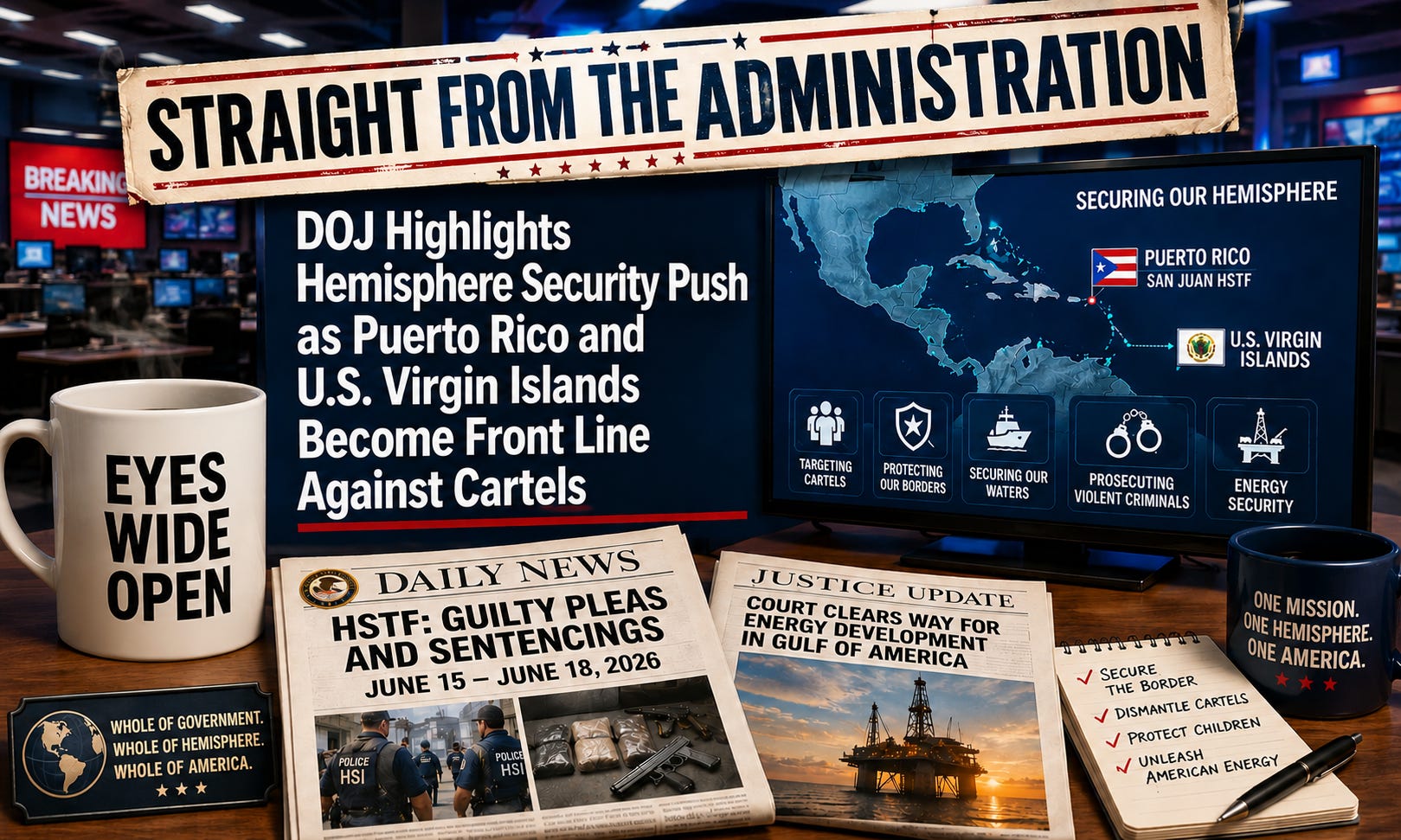
The Trump administration is continuing to signal that the Western Hemisphere is a central national security priority, with the Department of Justice highlighting a wave of guilty pleas, sentencings, and coordinated law enforcement actions centered in Puerto Rico and the U.S. Virgin Islands while simultaneously clearing the way for expanded American energy production in the Gulf of America.
Taken together, the announcements reinforce a broader administration theme that has emerged repeatedly in recent months: secure the hemisphere, dismantle transnational criminal organizations, strengthen strategic infrastructure, and increase American energy independence.
Resources for this article
Court Clears Way for Energy Development in Gulf of America
Puerto Rico and the Caribbean at the Center of Hemisphere Security
Convictions through Guilty Pleas and Sentencings in Homeland Security Task Force (HSTF) Prosecutions (June 15 through June 18, 2026)
According to the Department of Justice, the Homeland Security Task Force in San Juan announced multiple guilty pleas and lengthy prison sentences during the week of June 15 through June 18 involving drug trafficking conspiracies, machine guns, firearms offenses, and organized narcotics operations operating in Puerto Rico.
Rather than presenting the prosecutions as isolated criminal cases, the Justice Department explicitly tied them to President Donald Trump’s Executive Order 14159, Protecting the American People Against Invasion.
The department describes the Homeland Security Task Force as a permanent interagency organization created to target:
Transnational criminal organizations
International drug cartels
Human trafficking and smuggling networks
Foreign terrorist organizations
Violent criminal aliens
The announcement repeatedly frames these organizations as drivers of violence and instability affecting both the United States and neighboring regions.
A Hemisphere-Wide Coalition
One notable aspect of the release is the extraordinary number of agencies participating in the San Juan Homeland Security Task Force.
Federal partners include:
FBI
ICE Homeland Security Investigations
DEA
ATF
U.S. Marshals Service
U.S. Coast Guard
U.S. Secret Service
Department of State
Customs and Border Protection
TSA
FAA
IRS
U.S. Postal Inspection Service
The task force also integrates Puerto Rico and U.S. Virgin Islands law enforcement agencies, including the Virgin Islands Police Department, Puerto Rico Police Bureau, Puerto Rico National Guard Counter Drug Program, municipal police departments, corrections officials, and port authorities.
The inclusion of Puerto Rico and the U.S. Virgin Islands reflects the administration’s repeated emphasis on protecting maritime approaches to the United States throughout the Caribbean basin.
The U.S. Virgin Islands Continue to Hold Strategic Importance
Although this week’s prosecutions occurred primarily in Puerto Rico, the Justice Department again identified the U.S. Virgin Islands as a formal participant in the Homeland Security Task Force structure.
For months, administration statements across multiple departments have increasingly emphasized the Caribbean as a critical gateway into the United States and an important component of broader Western Hemisphere security.
The involvement of the U.S. Marshals Service for Puerto Rico and the U.S. Virgin Islands, the Virgin Islands Police Department, and the Puerto Rico/U.S. Virgin Islands High Intensity Drug Trafficking Area (HIDTA) illustrates that the federal government views the region as part of one integrated security environment.
Energy Security Joins Border Security
On Thursday, the Justice Department announced another victory supporting a separate administration priority.
A federal court dismissed litigation challenging offshore oil and gas development in the Gulf of America, allowing previously approved energy activities to move forward.
The decision follows an unprecedented unanimous vote by the Endangered Species Committee earlier this year exempting Gulf energy production from certain requirements of the Endangered Species Act after the Secretary of War determined the exemption was necessary for national security.
Principal Deputy Assistant Attorney General Adam Gustafson described the ruling as eliminating litigation that threatened domestic energy production and advancing President Trump’s directive to “unleash American energy.”
One Strategy, Multiple Fronts
Viewed together, the week’s announcements illustrate a consistent pattern emerging across the administration.
Whether combating international drug trafficking in Puerto Rico, coordinating with law enforcement in the U.S. Virgin Islands, securing maritime approaches throughout the Caribbean, or expanding domestic energy production in the Gulf of America, the administration continues to frame these initiatives as components of a broader national security strategy focused on strengthening the Western Hemisphere.
Rather than treating border enforcement, energy policy, and cartel prosecutions as separate issues, the Justice Department’s messaging increasingly presents them as interconnected elements of a single objective: securing America’s neighborhood while reducing vulnerabilities to foreign criminal organizations and strengthening U.S. strategic resilience.
This publication is organized around four core areas that help citizens understand the country they live in and the decisions made in their name.
Culture
Documenting the shared institutions that hold the nation together, including sports, traditions, and civic life.
Work
Restoring dignity through American manufacturing, industry, and the people who build and produce.
Sovereignty
Explaining national security, strategy, and policy clearly so citizens understand power and the choices made by government.
Civics
Educating citizens about the systems of self-government so they can participate knowledgeably in a free society.
Informed citizens make better voters.